Precision went global - the Q2 2026 rotation
Four independent layers, one finding. What Fundrella platform activity, real Swedish fund flows, pan-European fund flow data and the quarter's central-bank record all say about Q2 2026, and what they don't.
In Q1 2026 we found that search activity on our platform was getting specific. Country-level searches outweighed global wrappers, while Fondbolagens förenings statistics showed Swedish money moving into home markets. We called it selectivity over scope.
Q2 kept the precision and pointed it somewhere else. Here's what we saw and why we think it happened.
The Q2 2026 backdrop
The quarter inherited a warning. In March, reporting on the second half of 2025, the European Securities and Markets Authority flagged record-high global equity valuations and growing concern around US private credit. That was the ground Q2 opened on.
Then the Middle East conflict ran through all three months and brought an energy shock with it. West Texas Intermediate, the US crude benchmark, generally hovered between $90 and $110 a barrel in inflation-adjusted terms from early March until the US–Iran memorandum announced on June 14, then fell back toward pre-conflict levels by late June as the Strait of Hormuz partially reopened. Brent, the benchmark quoted in Europe, ran higher over the same months. US inflation traced the same arc: the May reading hit 4.2%, a three-year high, before cooling to 3.5% in June. Oil has partly reversed since, as the agreement broke down; inflation has continued to cool. These were levels the quarter lived under, not levels that hold today.
Central banks moved with the shock. The ECB raised its three key rates by 25 basis points on June 11, its first increase since September 2023 - citing inflation pressure from the war. The Fed held, cut the language pointing toward future cuts, and put a hike back on the table for year-end. Markets entered the quarter expecting cuts and left it pricing the opposite.
That is every reason to expect a defensive quarter. Equities rallied anyway, on earnings and AI. So what search activity came through on the Fundrella platform underneath that rally?
Three signals, cross-referenced
We publish a signal only where the layers agree - what allocators searched for on our platform, where money actually moved in Swedish and European fund flows, and a macro records that frames the why. One caveat before any of it: the mix of institutions searching on our platform shifted between Q1 and Q2, and some of what follows is what that shift alone would predict. That is exactly why we do not publish a platform signal until the flow data confirms it independently.
1. Global cores led the quarter
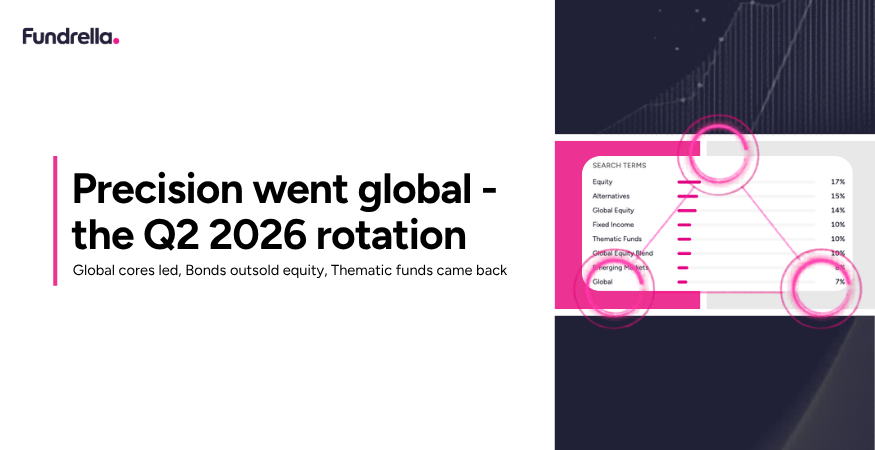
Global equity drew 14% of the platform activity over the quarter, global equity blend 10%. Single-country equity search thinned out.
Fondbolagens förenings monthly statistics show Swedish money going the same way. Global funds were the most popular equity category in April, May and June. Sweden funds, which led Q1, turned to net outflow in May and again in June, though they stay positive for the year. Global funds are a recovery story rather than a straight line: as late as the May statistics they were still listed among the categories in significant year-to-date outflow, and by the June release they were not.
The pan-European data points the same way, once you know how it is cut. LSEG sorts funds in to classifications - Equity Global, Equity US,Bond Global USD and so on, and in June Equity Global took more new money than any other single classification: €17.47bn, ahead of the next-largest by some margin. That is a ranking within classifications, not a claim that equity outsold bonds. At asset-class level bonds led the quarter, which is the subject of the next signal.
This is not a retreat from single countries in real money. US equity came back into favour across European flows over the quarter, on strong company earnings and enthusiasm for AI. Global and blended mandates grew- that's the claim. It isn't a verdict on geography.
For Asset Managers, over the quarter, global and blended-core equity found the most receptive audience, and standalone single-country wrappers lost share of platform activity. That's a reversal of the Q1 signal.
2. A defensive tilt to fixed income
Fixed income searches on the Fundrella platform increased against Q1.
Fondbolagens förenings monthly statistics show the same tilt in Swedish real money. Long bond funds took SEK 24.8bn across the quarter and were positive every month. Corporate bond funds took 4.1bn of that in April, 4.3bn in May and 4.1bn in June - half of all long-bond inflows, and within 0.2bn of the same figure three months running. Add short bond funds and fixed income outsold equity over the quarter: SEK 33.8bn against 31.0bn, summing the monthly releases.
Morningstar found the same across Europe. Bond funds took €84.1bn against €72.4bn into equity - bonds up from €75.7bn the previous quarter while equity fell from €98.6bn - with Morningstar attributing the demand particularly to inflation-linked and emerging-market bond funds. Inflation-linked took €2.5bn of that - small against the €84.1bn total, but a second strong quarterin a row.
The regime is consistent with all of it. Rates stayed higher than Q1's path implied: the ECB raised on June 11, its first increase since September2023, and the Fed held while dropping the language pointing toward cuts. A quarter with a war and an energy shock is one where contractual income competes well. The clearest rate-linked detail sits inside the Swedish figures - June was the only month when short bond funds outsold long ones, SEK 5.8bn against 4.4bn, and short duration is the less exposed of the two to further rises. We report a regime consistent with these flows, not one that produced them.
For Asset Managers, credit fixed income had the clearest run of the quarter - and, at the European level, inflation-linked and emerging-market debt. It's the signal we'd put most weight on.
3. Thematic and technology came back
Thematic funds drew 10% of the searches on the Fundrella platform in Q2, up sharply from a low base in Q1. This was one of the sharpest composition shifts in the quarter's search mix, and the earliest read we have on a shelf reopening. What the flow data show alongside it is real, but more modest.
Morningstar recorded European thematic funds turning positive for the first time since Q1 2023 - three years of outflow, then €0.9bn of inflow. Modest in absolute terms, and we'd rather say so than lead on direction alone. Technology funds took €11.7bn, their strongest since early 2021.
Infrastructure took €3.8bn on data-centre demand, which is the same AI story in different clothes.
This one is softer than the other two. Swedish fund statistics have no thematic classification, so that layer can't confirm it. The nearest equivalent, sector funds, was in year-to-date outflow through the quarter. Sector funds aren't thematic funds, so that isn't a contradiction - but we treat the Swedish layer as neutral here rather than confirming.
What it means
Q1 pointed Asset Managers toward country-tagged distribution. Q2 inverts that, toward global and blended cores, while carrying the Q1 fixed income rotation forward and sharpening it into credit. Thematic funds returned to inflow after three years out, though modestly.
Fixed income is the signal to act on first. Both action layers show it outselling equity on separate data: SEK 33.8bn against 31.0bn in Sweden, €84.1bn against €72.4bn across Europe.